Defines a multidimensional functional data set.
Constructor function of the npf.data-class.
as.npf.data() converts functional data to a npf.data-class object.
npf.data(y, min, max, lag, ylabel, ynames, dimnames)

# S3 method for class 'npf.data'
coords(x, ...)

as.npf.data(obj, ...)

# Default S3 method
as.npf.data(obj, ...)

# S3 method for class 'array'
as.npf.data(obj, ...)

# S3 method for class 'fdata'
as.npf.data(
  obj,
  ylabel = NULL,
  ynames = NULL,
  dimnames = NULL,
  tol = sqrt(.Machine$double.eps),
  ...
)
Arguments
- y
numeric matrix or array; the last dimension corresponds to curves and the first ones to discretization points.
- min
vector; minimum values of the discretization points (coordinates).
- max
vector; maximum values of the discretization points (optional).
- lag
vector; lag in each dimension (optional).
- ylabel
character; name used to label the data.
- ynames
character vector; names used to label the curves.
- dimnames
character vector; names used to label the dimensions.
- x
funcional data (npf.data-class object).
- ...
further arguments passed to
npf.data().- obj
a functional data object.
- tol
numerical tolerance used to check whether the discretization points are regularly spaced
Value
Returns an object of class npf.data
(extending npsp::data.grid), a list with
the arguments y, ylabel and ynames as components, and two additional
components:
nynumber of curves (sample size).grida npsp::grid.par-class object that defines the discretization points.
Details
Only one of the arguments max or lag must be specified.
See also
Examples
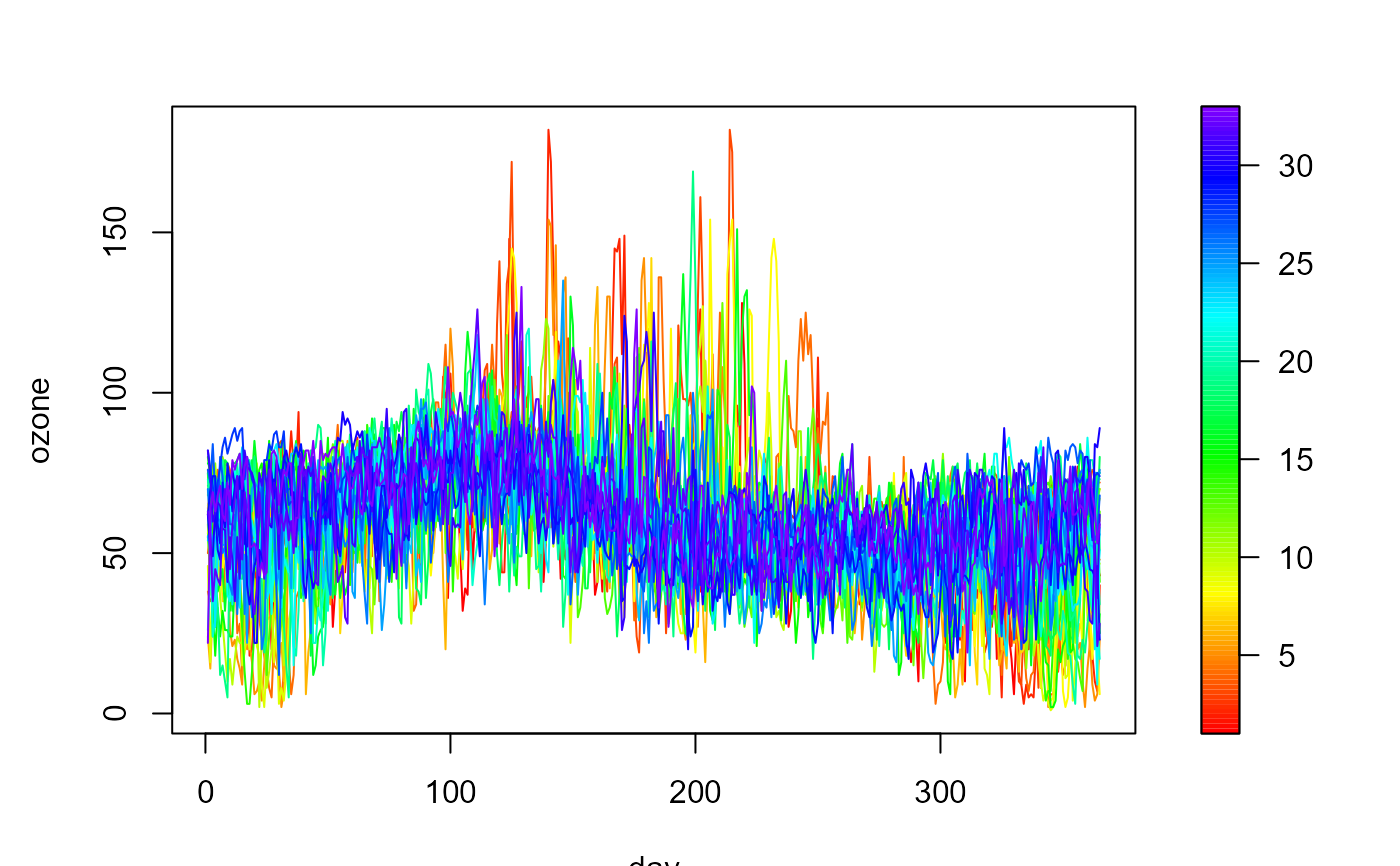
fd.ozone <- npf.data(ozone, dimnames = "day")
plot(fd.ozone)